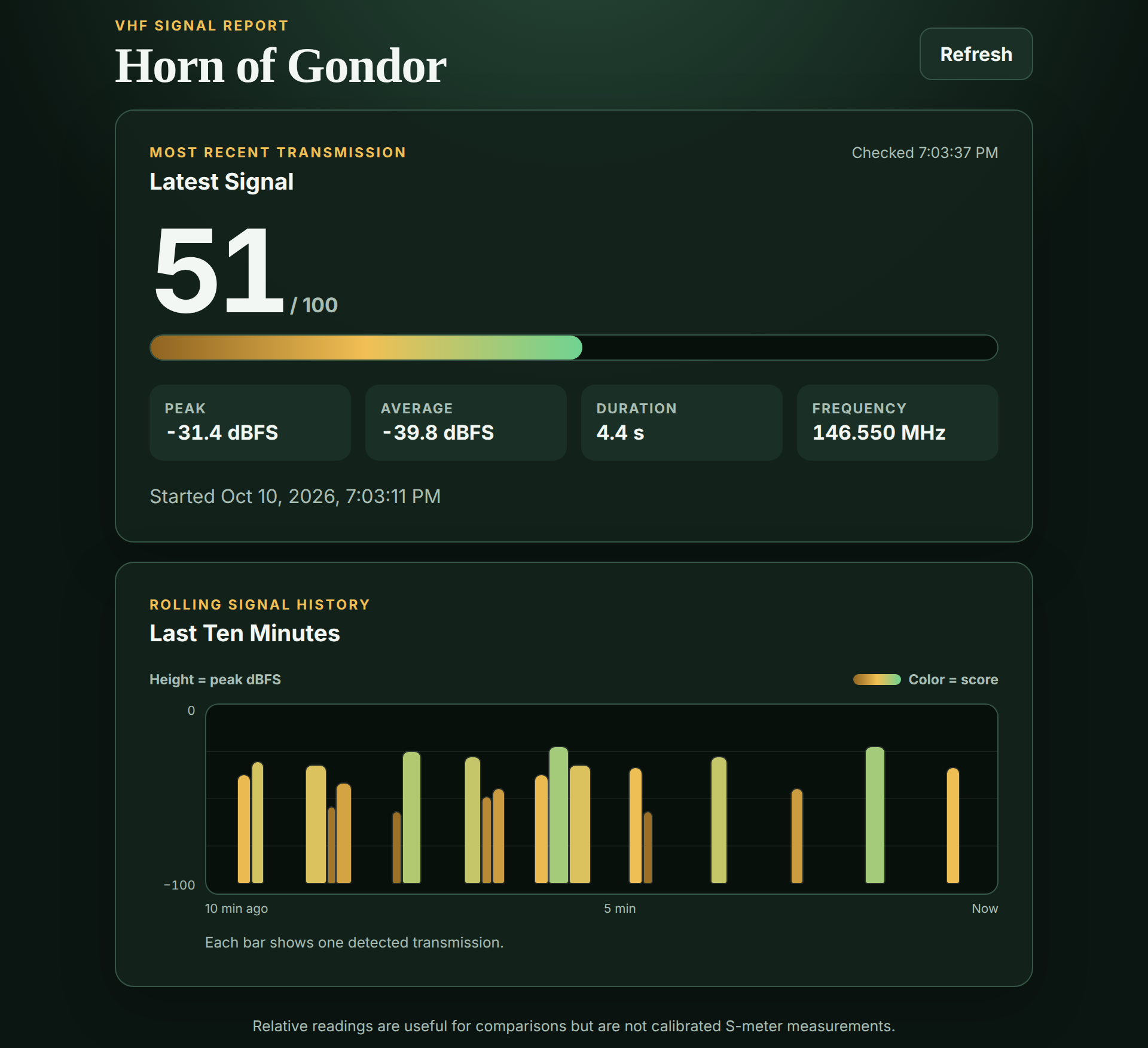
Horn of Gondor is an open-source reverse radio beacon for testing Ham HT’s (VHF handheld radios). It listens for transmissions, measures relative signal strength, and publishes the results online in almost-real time. You can go to the website and play a short recording of each transmission to hear what it sounded like at the receiver.
I built it because I wanted to know how well I could be heard around my neighborhood, and beyond, on my ham HT. Just getting a signal strength number (i.e. “5x9”) is a pain in the butt, and it only tells you so much. I wanted something like that number, and the human answer, too: how does it sound to me. I also wanted an excuse to vibe code something radio with a Raspberry Pi.
The hardware is simple: a Raspberry Pi 3 Model B+ with an RTL-SDR V3 as the receiver. The antenna is a spare mobile car antenna (thanks, Matt!) on a makeshift ground plane, sitting on a bookcase. It runs unattended as a system service on my home wifi.
On the software side, a Node.js receiver handles FM detection, signal scoring, an SQLite queue, and short WAV recordings. Cloudflare Workers, D1, and R2 provide the API, measurement history, website hosting, and audio storage.
This is where AI was really handy. I know JavaScript and Node, but I had never used Cloudflare to host anything or store data. AI helped me do both easily — an important task and also something I didn’t really care about the internals of, and didn’t want to learn.
The website UI is mobile-first. It shows the latest score a bar chart for transmissions received over the last ten minutes. Bar height is peak strength, color is the score, and width is duration. Tap a bar to hear the recording.
The whole pipeline, from Pi to cloud to my phone, worked on the first try. So far my reception is weaker than I expect based on my personal radio experience. I’m trying different antennas and receiver setups to find out why.
But hey, part of the fun of radio is experimenting!